Georg Klaus and the four layers of data quality
A 1963 addition to semiotics turns out to be a useful framework for data quality problems.
Today's post is about a 20th-century East German philosopher.... Stay with me.
Semiotics is the study of signs.
How they work, what they mean, how meaning gets transmitted from one mind to another through the things we use to stand for ideas. Words, symbols, gestures, charts AND database fields. Anything that points at something other than itself is a sign, and the rules governing how signs do that work are what semiotics tries to explain.
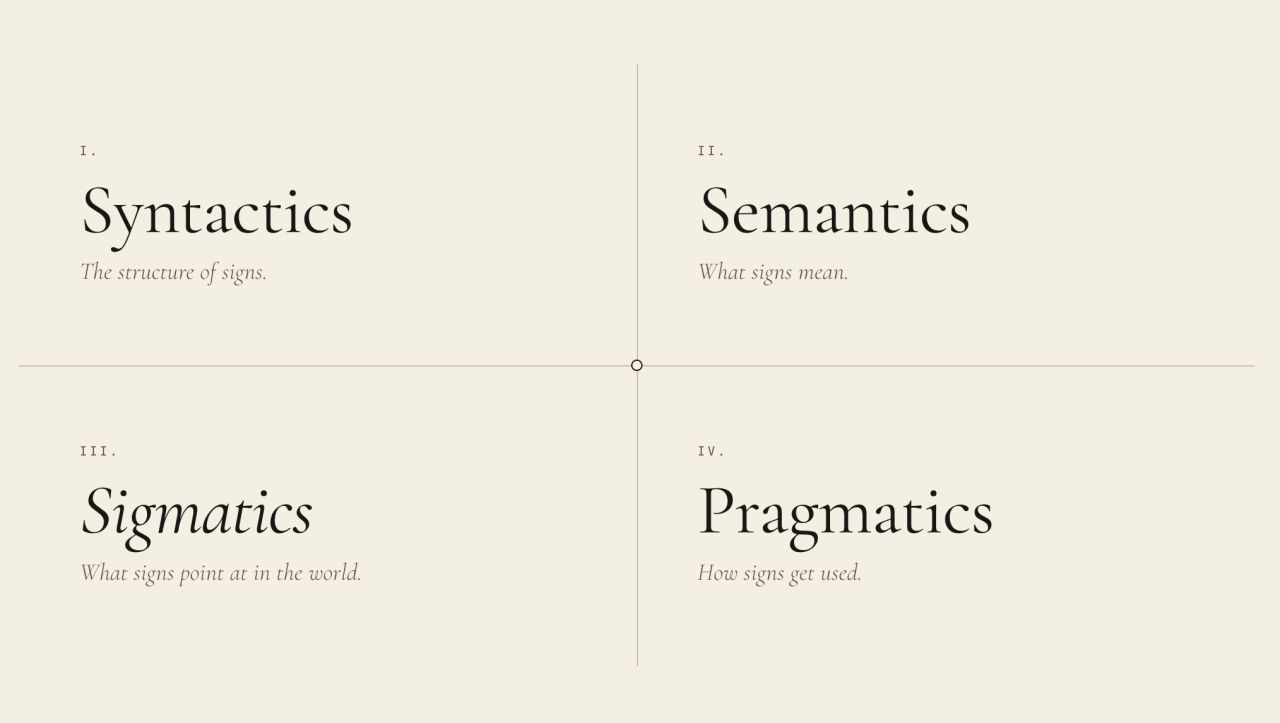
Charles Morris defined 3, Syntactics (the structure of signs), Semantics (what signs mean), and Pragmatics (how signs get used).
In 1963 an East German philosopher (and Marxist-Leninist epistemologist) named Georg Klaus argued there should be 4: sigmatics, the study of what a sign actually points at in the real world.
These 4 definitions make a useful framework for Data Quality.
Syntactics is the schema. property_id is a string. square_footage is an integer. The foreign key from a unit to a building resolves. The row loads. This is the layer most data tooling was built to govern.
Semantics is the definition. square_footage denotes the idea of usable interior area. The team has a data dictionary. The dictionary has an entry. The entry says what the field means in the abstract. Whether that abstract definition is rentable area, gross area, or carpet area is a separate question most organizations are honest enough to admit they have not answered.
Sigmatics is the referent. APN 123-456-789 used to point at a single ten-acre parcel. After subdivision, three parcels exist where there was one, and the old APN no longer points at anything that exists in the world. Or consider the row in your data for a building that was demolished in 2019. The sign is still there. The referent is gone. This is the layer where entity resolution lives, and almost no governance program covers it.
Pragmatics is the use. The same occupancy field means something different to a leasing team chasing renewals than to a valuations team modeling NOI than to a lender testing covenant compliance. The data is identical. The interpretation is not. Most "the dashboard is technically correct but no one trusts the number" problems live here.
Every data quality issue in real assets lives at one of these four layers.
- A schema mismatch is syntactic. Easy to spot, easy to fix.
- A definition disagreement is semantic. Harder. Requires conversation.
- A broken or duplicated property identifier is sigmatic. Often invisible to the team that produced it.
- A misuse in context is pragmatic. The data is fine. The interpretation is wrong.
Most data quality programs operate at the first layer and call it governance. That is why so many of them ship clean rows that produce wrong decisions.
The shape of the next decade of real asset data infrastructure is the layers nobody took time to build.
Next week: Aristotle on the Problem of Universals, and why your data dictionary is secretly a nominalist, pretending to be realist...seriously :)
First posted on LinkedIn.